
In 2026 Google’s search results look very different. Instead of a long list of blue links, many queries now trigger “AI Overviews” – generative summaries that answer questions directly. For small businesses this change can feel like losing visibility, but it’s actually an opportunity to become the trusted source Google cites.
Definition/overview
AI Overviews are Google’s generative answers shown above the traditional search results. When someone asks a complex question, the system pulls information from multiple web pages, synthesises it, and displays a concise answer with links to the cited sources. These overviews don’t replace organic results – they sit at the top of the page and link back to reputable sites. Google has emphasised that AI Overviews prioritise helpful content, strong entity signals and clear structure. If your pages are well organised, demonstrate experience and expertise, and use descriptive headings, they are more likely to be referenced. The focus isn’t on tricks or keyword stuffing; it’s on becoming the source the AI trusts to answer the query.
Official guidance worth following: Google’s helpful content guidance and Google Search Central documentation.
Why the old way fails / common mistakes
Traditional SEO tactics like over-optimised keywords, thin pages or buying links don’t work in an AI-driven world. Small businesses that churn out generic blogs, duplicate service pages for every suburb or stuff keywords into invisible text are sending the wrong signals. AI Overviews look for authoritative answers; they penalise sites that publish low value content. Common mistakes include writing for search engines instead of people, ignoring clear subheadings, neglecting author profiles and forgetting to update outdated facts. Another error is chasing every trending topic even if it’s unrelated to your business. These tactics might have produced short-term traffic years ago, but they undermine trust today.
Core principles
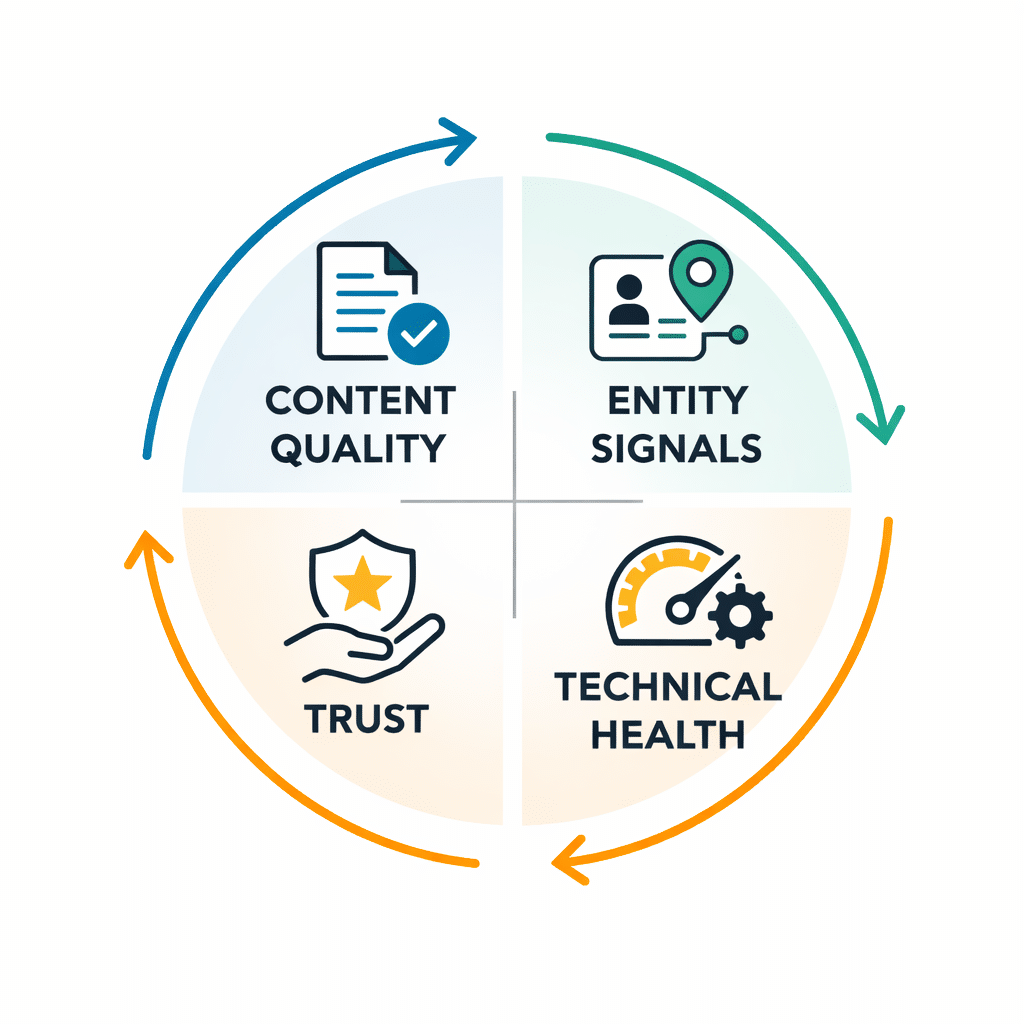
To earn a place in AI Overviews you need to embrace quality over quantity. The following principles should guide every page you publish.
- Write for people first. Provide original insights, clear answers and practical information that readers would bookmark.
- Demonstrate E-E-A-T: show experience, expertise, authoritativeness and trustworthiness through detailed explanations, transparent about pages and sources.
- Send clear entity signals by using your business name, address and contact details consistently and by implementing LocalBusiness schema where appropriate.
- Structure content with descriptive headings and subheadings. Avoid sensational titles; summarise what the page actually covers.
- Optimise for accessibility and speed. Use alt text for images, compress assets and ensure your site passes core performance tests.
Step-by-step implementation
Here’s a practical roadmap to prepare your site for AI Overviews. Use it as a checklist to audit existing pages and guide new projects.
- Audit your existing content for originality and usefulness. Remove or update thin or outdated pages.
- Define the core topics and entities you want to be known for. Align them with your products or services.
- Create outlines that mirror user questions. Use clear H2 and H3 headings to structure answers.
- Implement structured data such as FAQ, HowTo or LocalBusiness schema to reinforce entity signals.
- Highlight author credentials and business expertise on profile pages and in your footer.
- Check technical health: compress images, remove unused scripts and ensure your site loads quickly on mobile.
- Monitor performance in Search Console and adjust your content based on impressions and clicks from AI Overviews.
- Update content regularly when information changes, rather than changing dates without adding value.
AI Overview readiness checklist
- Original, in-depth pages answering real customer questions.
- Descriptive titles and headings that summarise the content.
- Consistent use of your business name, address and phone across the site.
- Schema markup implemented for articles, FAQs and local information.
- Author pages with bios and credentials.
- Fast, mobile-friendly design verified through testing tools.
- Regular updates to keep facts current.
|
Signal you control |
What it affects |
What to do this week |
|
Content quality |
Relevance and helpfulness |
Expand or consolidate thin pages and add unique insights. |
|
Entity signals |
Recognition of your brand |
Update NAP details site‑wide and add schema. |
|
Technical performance |
User experience and crawlability |
Compress images and defer unneeded scripts. |
|
User engagement |
Trust signals |
Encourage reviews and include customer quotes within content. |
|
External credibility |
Authority |
Seek natural mentions from suppliers, partners and local media. |
Mini example
A local home-renovation company published a detailed guide on choosing sustainable materials. They included step-by-step instructions, a FAQ section and an author bio explaining the builder’s 20-year career. Within a few months their guide was referenced in AI Overviews for queries about eco-friendly renovations. The key wasn’t luck – it was original content, clear structure and visible expertise.
How D-Legion Software helps
Optimising for AI Overviews can feel daunting, but you don’t have to do it alone. At D-Legion Software we specialise in ethical SEO and digital marketing for Australian small businesses. Our team performs in-depth audits, restructures your content around user intent and implements best practice improvements. We also offer design and development services to ensure your site is fast, accessible and easy to crawl. See examples of our work in our portfolio. To learn more about our tailored online marketing and SEO Brisbane services, and how we can help your business earn visibility in AI Overviews, reach out to our contact team today.
FAQs
How can my small business appear in AI Overviews?
Focus on publishing original, helpful content that answers real customer questions. Use descriptive headings, implement appropriate schema and maintain consistent business information. Ensure that your pages load quickly and are easy to navigate. By demonstrating expertise and trustworthiness you increase the likelihood of being cited in AI Overviews.
How often should I update my content for AI Overviews?
Update your pages when facts change or when you have new insights to share. There’s no need to refresh dates without adding substantial value – AI systems recognise genuine updates. Schedule periodic reviews to ensure contact details, product information and statistics remain accurate.
What should I change first to prepare for generative search?
Start by auditing your existing content for quality and structure. Prioritise pages that already attract traffic and make them more comprehensive. Add schema where relevant, create author bios and improve site speed. Once the foundations are strong you can expand into new topics with confidence.